

Monad and the Rise of Parallel EVM: Redefining Layer-1 Throughput Economics
Overview
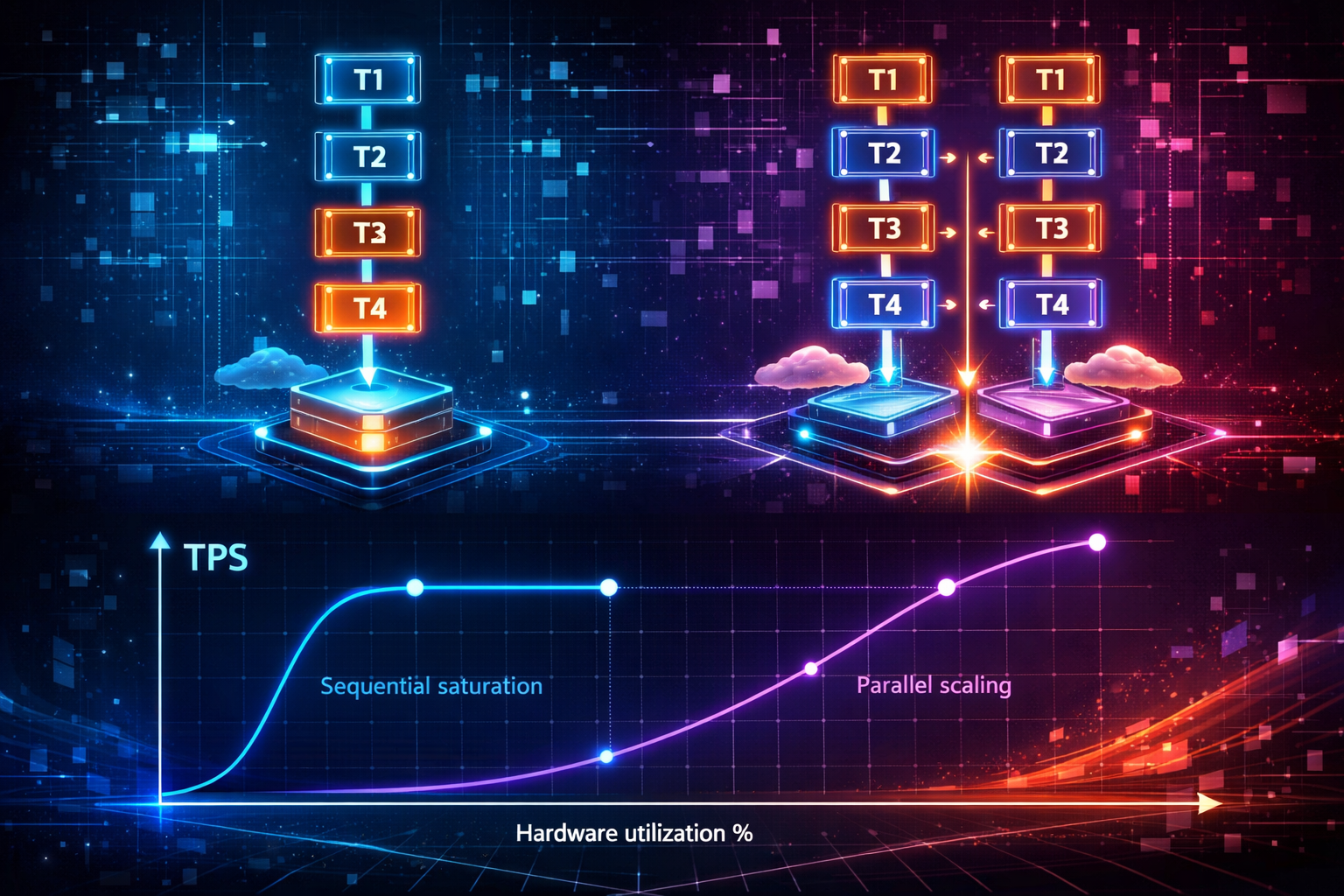
Monad's core bet is simple: you should not need to abandon Ethereum bytecode compatibility to get modern throughput. Monad blocks remain linearly ordered like Ethereum blocks, but nodes can execute independent transactions in parallel so long as the final result matches the ordered EVM outcome. (docs.monad.xyz) This is important because "parallel EVM" often sounds like a semantics change - Monad's documentation stresses the opposite: execution is parallelized, but determinism and end-state equivalence are preserved. (docs.monad.xyz)
The mechanical unlock is optimistic parallelism plus an execution pipeline. Monad describes separating consensus and execution ("asynchronous / deferred execution") so the chain isn't forced to spend most of its block time waiting on network-wide consensus before doing meaningful work. (blog.monad.xyz) By decoupling stages, and by scheduling non-overlapping transactions across cores, the validator is pushed toward a CPU-style model: more threads, better utilization, higher effective throughput. (docs.monad.xyz) That design has a second constraint: state access becomes the bottleneck. Monad's own architecture writing calls out storage I/O and state reads/writes as the limiting factor for EVM execution, and positions "MonadDb" style improvements (fewer IOPS per read/write, faster root updates, parallel reads) as what makes parallel execution actually pay off in practice. (blog.monad.xyz) In other words, parallel execution is not just a scheduler - it is only as good as the state backend and conflict rate allow.
Sources
- Parallel execution without semantic changes: blocks remain linearly ordered; execution can be parallel while producing Ethereum-equivalent results. (docs.monad.xyz)
- Deferred execution improves pipeline utilization: Monad separates consensus and execution stages so execution time isn't dominated by consensus latency. (blog.monad.xyz)
- State backend is the real limiter: parallelism only pays off if storage/state access supports high parallel read/write throughput. (blog.monad.xyz)
- Validator economics shift toward efficiency: higher utilization can lower marginal cost per tx, but raises the bar on hardware quality and ops tuning. (docs.monad.xyz)