


MIP-9: Monad Proposes Validator Active Set Expansion
Overview
Written on April 1, 2026. Monad governance discussions have introduced MIP-9, a proposal focused on increasing the validator active set size. The proposal is still in the discussion and formalization phase rather than enactment, but it is strategically important because it frames the next phase of Monad's validator lifecycle as mainnet onboarding moves beyond the earliest rollout window. At its core, MIP-9 asks how quickly Monad should expand the validator active set without compromising performance and stability. In early network stages, smaller active sets help maintain tighter coordination, lower consensus overhead, and cleaner validation of operator reliability. As the network matures, though, a larger active set becomes materially important for decentralization, resilience, and censorship resistance. That makes MIP-9 both a governance topic and a technical constraint problem. Increasing the number of active validators affects consensus latency, network communication overhead, block propagation behavior, and voting performance. For Monad's pipelined architecture, active-set growth has to preserve performance guarantees rather than function as a symbolic decentralization setting.
The proposal is also closely tied to validator onboarding. As new validators progress through the VDP and Wave 2 pipeline, the network needs a path to admit them into real block-producing participation. Without active-set growth, more validators can be approved and delegated while still waiting outside the active path. MIP-9 is the framework that can widen participation while keeping growth deliberate. For operators, that means MIP-9 introduces opportunity and competition at the same time. More slots create room for additional validators, but they also reinforce the expectation that uptime, monitoring, security, and operational discipline remain the bar for inclusion.
Current Decentralization Baseline
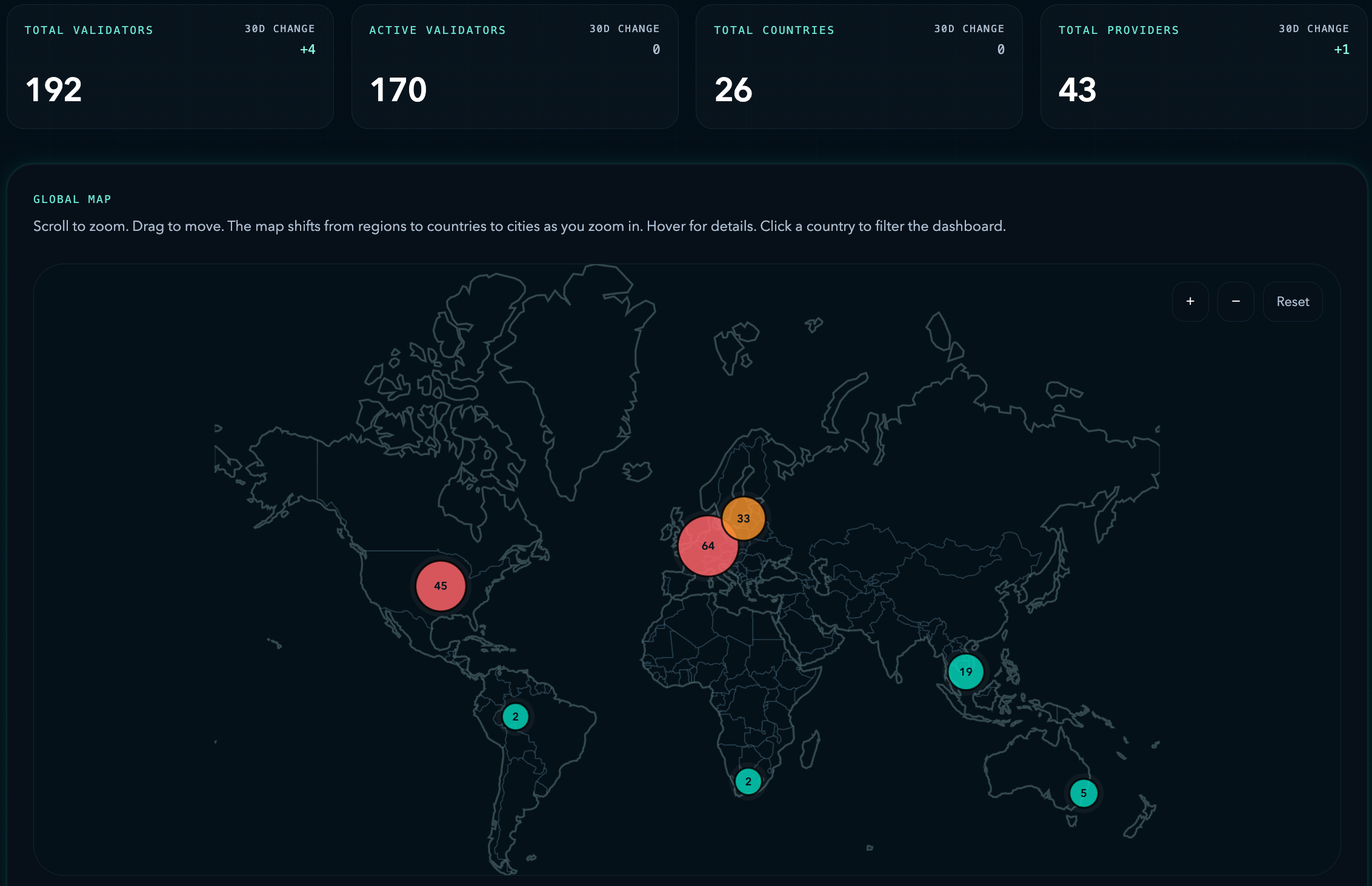
Context
One practical way to think about MIP-9 is through the lens of the current validator footprint. BitCtrl's Monad Geo dashboard provides a live map and provider-distribution view that helps operators and delegators understand the decentralization surface MIP-9 is trying to widen over time. If active-set expansion moves forward, that baseline becomes more useful, because geography and provider diversity become easier to measure against a growing active set rather than a tightly bounded one.
Why the Proposal Matters
- Early-stage smaller validator sets help keep coordination tighter while mainnet behavior is still being proven.
- A larger active set is eventually required for decentralization, resilience, and censorship resistance.
- MIP-9 frames that expansion as controlled growth rather than an immediate large jump.
- The main tradeoff is preserving performance while widening participation.
Operator Notes
- Monitor the MIP-9 forum thread and the MIPs repository pull request for parameter updates and formalization progress.
- Expect phased activation if the proposal advances, not instant full-scale expansion.
- Keep infrastructure, monitoring, and incident handling standards high, because active-set growth still depends on operational quality.
- Use geography and provider-mix views, including Monad Geo, to track whether decentralization actually improves as new validators enter.
Sources
- MIP-9 proposes increasing Monad's validator active set as part of network decentralization.
- Expansion is tied to ongoing validator onboarding through the VDP and Wave 2 pipeline.
- The proposal balances performance constraints with decentralization goals rather than treating active-set growth as symbolic only.
- Validators should prepare for gradual inclusion into the active set if governance formalization continues.